
What Actually Shapes a Product Strategy: The Problems That Don’t Go Away
Synopsis
Across industries, the same pattern keeps showing up: messy inputs, noisy competitor moves, and tools that break under real conditions. This article explores how those recurring problems helped shape Pagezii.
What actually shapes a product: the problems that don’t go away
Across different industries, the same pattern repeats.
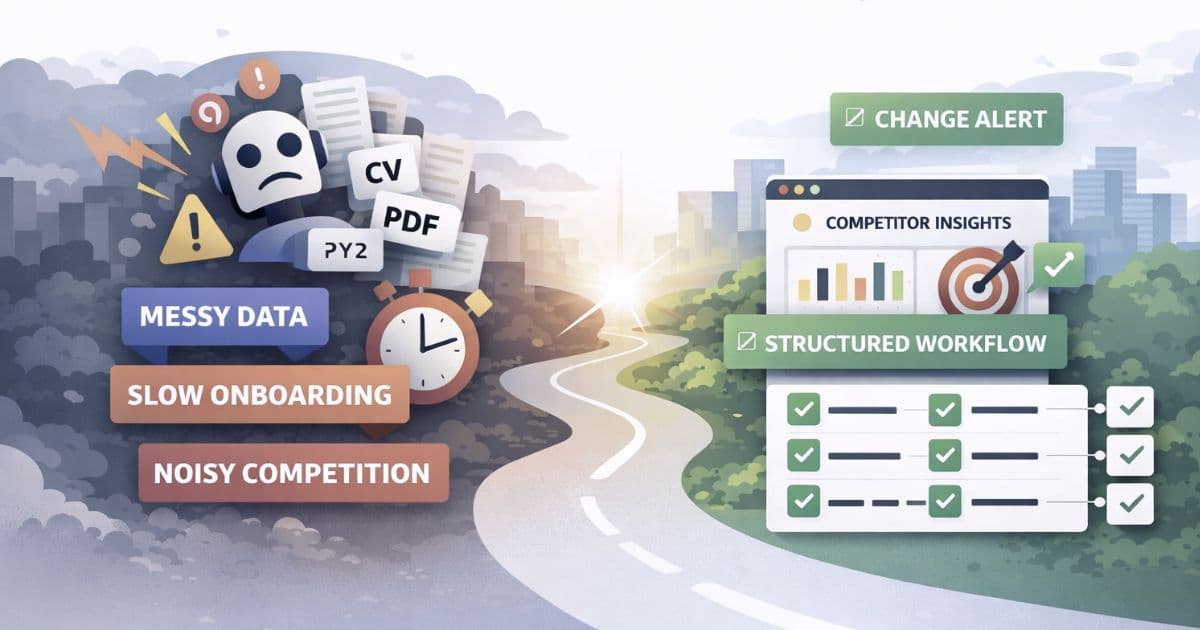
Inputs are messy. Competition is noisy. Tools promise automation, but break under real conditions.
Pagezii was not built from theory. It was shaped by these recurring constraints, observed across operators dealing with real workflows.
1. When automation fails on real-world data
At BetterQA, Managing Director Tudor Brad described the gap clearly:
“The real challenge wasn’t automation. It was handling the chaos of real-world recruitment.”
This company experienced this pain →
AI parsing promised efficiency, but produced broken outputs, misaligned data, and hours of manual correction.
They addressed it this way →
They stress-tested their system against worst-case inputs. Messy PDFs, scanned CVs, multi-language formats. Accuracy improved only through exposure to chaos.
This is one of the reasons we built Pagezii →
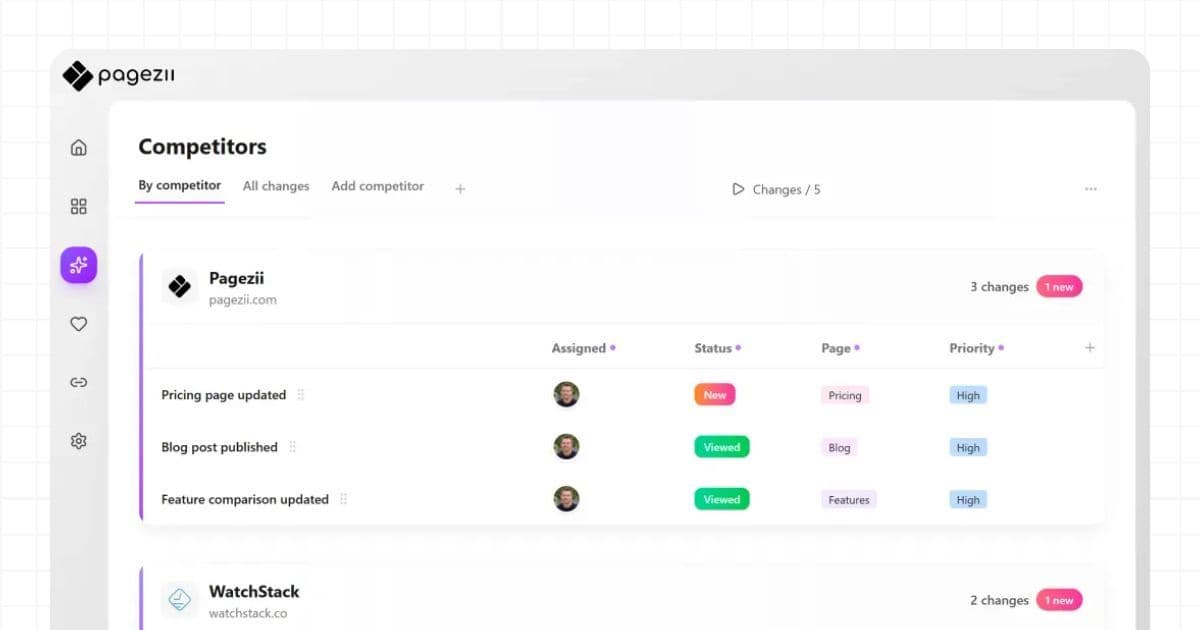
Pagezii ingests messy, unstructured pages (pricing tables, PDFs, changelogs) and still produces structured outputs using noise filters and normalization layers. In practice, a product manager sees a clean, usable diff instead of raw clutter.
Company: https://betterqa.co
2. When onboarding becomes the bottleneck
At VoiceAIWrapper, Co-Founder Raj Baruah identified a different constraint:
“Our best competitive intelligence came from what customers were already telling us.”
This company experienced this pain →
Strong product depth, but slow onboarding meant users dropped off before reaching value.
They addressed it this way →
They introduced a guided setup flow, reducing time-to-value and improving conversion.
This is one of the reasons we built Pagezii →
Pagezii surfaces value immediately through tracked pages and automatic change alerts, without requiring complex setup. In practice, users start seeing competitor movements within minutes, not weeks.
If you’re dealing with messy inputs and noisy competitors, Pagezii helps you structure that chaos into weekly competitive briefs. See how it works in a 15‑minute demo.
Company: https://voiceaiwrapper.com
3. When competitors create noise, not strategy
At New York Custom Labels, CEO Myles Schepetin observed a pricing shift:
“They were the only one trying to race to the bottom.”
This company experienced this pain →
A competitor removed minimum order requirements, creating pressure to respond.
They addressed it this way →
They audited the market and chose not to follow. Instead, they reinforced quality positioning.
This is one of the reasons we built Pagezii →
Pagezii filters out low-signal competitive noise and highlights meaningful changes. In practice, teams focus on strategic shifts, not reactive moves that do not sustain.
Company: https://www.newyorkcustomlabels.com
4. When AI increases output but reduces clarity
At Cliprise, Founder Kruno Sulic reframed the problem:
“Content became cheap, but clarity and operational intelligence became scarce.”
This company experienced this pain →
AI tools produced large volumes of content, but teams struggled with quality and differentiation.
They addressed it this way →
They introduced structured workflows and human validation, shifting from volume to decision-making.
This is one of the reasons we built Pagezii →
Pagezii structures competitive intelligence into teardown workflows and actionable summaries. In practice, teams move from raw updates to clear decisions without manual synthesis.
Company: https://www.cliprise.app
What ties these together
The same constraints appear across all cases:
- Real inputs are inconsistent and unstructured
- Time-to-value determines adoption
- Competitive signals are noisy and often misleading
- AI without structure produces volume, not clarity
Pagezii is built around these realities.
Closing perspective
Most tools work well in controlled environments. The failure happens at the edges, where inputs are messy, signals are unclear, and time is limited.
Pagezii is designed for those conditions.
About the Author

Jenna Gallo
Business Development
Jenna Gallo
Business Development
Jenna supports Pagezii’s business development, partnering with founders and teams while sharing insights on competitive intelligence and strategy.
Frequently Asked Questions
Pagezii is built to handle messy, unstructured inputs and convert them into clear, actionable insights. It focuses on reducing noise in competitive signals and helping teams move from raw information to decisions quickly.
Audience Context
This article is intended for product leaders, founders, growth teams, and operators evaluating how real-world constraints shape product direction. It focuses on practical patterns such as messy data inputs, onboarding friction, competitive noise, and AI workflow limitations, with examples drawn from operating teams and real product environments.
Related Insights
- How competitors use blog content as a strategic signal — Reading rival content for early strategy signals
- We tracked 5 competitors manually for 6 months — What manual tracking misses
- Competitor DNS and tech stack signals — Technical intelligence layer
- Competitor content strategy examples worth monitoring — Real-world content signal examples
- How to monitor competitor backlink moves — Backlink strategy as a competitive signal
References
- Harvard Business Review. (2024). The critical link between product management and business strategy. California Management Review. https://cmr.berkeley.edu/2024/06/the-critical-link-between-product-management-and-business-strategy-the-product-objective-initia
- Lucid. (2022). How to fix 6 common product strategy mistakes. Lucidchart Blog. https://lucid.co/blog/how-to-fix-common-product-strategy-mistakes
- Product School. (2023). The 8 most common product development challenges. Product School Blog. https://productschool.com/blog/product-strategy/product-development-challenges
- ZOCO Design. (2025). 9 common product strategy problems (and how to solve them). ZOCO Design Blog. https://zocodesign.com/blog/9-common-product-strategy-problems-and-how-to-solve-them
- Comintelli. (2025). Mastering intelligence: Best practices, behaviors, and use cases in competitive intelligence. https://comintelli.com/mastering-intelligence-best-practices-behaviors-and-use-cases-in-competitive-intelligence
- Productboard. (2025). How AI is reshaping the product management workflow. Productboard Blog. https://www.productboard.com/blog/how-ai-is-reshaping-the-pm-workflow/
- Coveo. (2024). The complete guide to data cleaning best practices. https://www.coveo.com/blog/data-cleaning-best-practices/
Disclaimer
The examples referenced are based on input provided directly by the companies and their owners or leadership. They are included to illustrate common product challenges and approaches, and should not be interpreted as verified case studies or endorsements. Outcomes may vary depending on context, implementation, and market conditions. Pagezii capabilities described reflect typical use cases and may evolve over time.