

We Tracked 5 Competitors Manually for 6 Months. Here's What Manual Competitor Tracking Missed.
Synopsis
Written from a founder's POV, this post walks through three specific missed signals during six months of manual competitor monitoring: a pricing change that surfaced mid-sales-call, a feature launch discovered three weeks late, and a strategic blog post that signaled a competitor pivot.
The Setup: How Manual Competitor Tracking Actually Works
If you are still relying on manual competitor tracking, this six-month experiment shows exactly what you are missing and why it hurts deals.
Most founders start tracking competitors the same way. A shared spreadsheet. A folder of bookmarked URLs. A recurring reminder to check in on Friday afternoon that gets skipped more often than not.
If you are still using a competitor tracking spreadsheet, start here: replace your competitor tracking spreadsheet.
For six months, that was the system. Five competitors. Roughly three hours per week split across two people. It felt manageable because most weeks nothing changed. The problem was the weeks when things did change.
Here is what slipped through.
Competitors update on Tuesdays. You check on Fridays. That three-day gap is where deals are lost.
Missed Signal 1: A Pricing Change During a Live Sales Call
One of the five competitors quietly dropped their entry-level plan by 30 percent. No announcement. No email to the market. Just a pricing page update on a Tuesday afternoon.
Competitors never announce pricing changes. By the time a prospect mentions it in your demo, your sales team is already on the back foot.
We found out on a Thursday, three days later, when a prospect mentioned it mid-demo. "I was looking at your pricing versus theirs and noticed they dropped their starter tier. Can you match that?"
We could not answer confidently in the moment. We had to follow up. The deal did not close that week.
A pricing change that takes 30 seconds to make on a webpage took us three days to find out about. By then, the damage was already in a sales conversation.
This is not a one-off scenario. Pricing changes are the most common blind spot in manual tracking because they happen without announcements and they hit you where it hurts most: in the deal. For a deeper look at how pricing changes affect your pipeline, read competitor pricing change alerts.
Missed Signal 2: A Feature Launch Discovered Three Weeks Late
The second miss was a feature launch. A competitor added a native integration with a CRM that several of our prospects had specifically asked us about. We found out not from checking their features page, but from a customer who had been evaluating both products.
Three weeks had passed. In that time, the competitor had already published a blog post about it, collected early reviews, and had sales reps using it as a differentiator in demos.
We were responding to a conversation that was already three weeks old.
The issue is not that we were not paying attention. The issue is that manual tracking is episodic. You check when you remember to check. Competitors update when they want to update. Those two schedules rarely align.
Missed Signal 3: A Strategic Blog Post That Signaled a Pivot
This one was the most expensive miss in the long run.
A competitor published a blog post about a specific use case we had been developing toward. Not a product announcement. Just an exploratory post about the problem, the buyer persona, and the approach. Standard content marketing.
A competitor's blog post is often a six-week preview of their next product move. Treat new content as a strategic signal, not just marketing noise.
We found it two months after it was published. By then, they had indexed related content, built backlinks, and started capturing organic traffic for the exact queries we were planning to target.
A blog post is not a product launch. But it is often how companies signal strategic direction before they announce it. Catching it early gives you time to evaluate whether to compete, differentiate, or accelerate. Finding it two months late gives you none of those options.
For product teams specifically, this kind of signal is the most important one to catch early. See how teams use competitor content monitoring to protect their roadmap: competitor monitoring for product roadmap protection.
What Automated Tracking Would Have Caught
With automated monitoring in place, here is when each of those signals would have surfaced:
The pricing change: same day it happened. An alert to email the moment the page changed, with a summary of what was different.
The feature launch: within 24 hours of the features page update. Enough time to brief the sales team before the next round of demos.
The strategic blog post: the day it was published. An alert tied to the competitor's blog page, flagged as a new post in the weekly summary.
None of these require sophisticated analysis. They require consistent monitoring of the pages that matter, which is exactly what manual checking fails to deliver reliably.
The Real Cost
Six months of manual tracking across five competitors added up to roughly 75 hours of time between two people. That is a conservative estimate. It does not include the time spent reacting to the signals we caught late.
In practice, manual competitor tracking cost us 75+ hours and multiple missed revenue opportunities.
For a detailed breakdown of what manual tracking actually costs in time and missed intelligence, read The Hidden Cost of Manual Competitor Tracking.
To see what a month of automated tracking actually produces, read What 30 Days of Automated Competitor Tracking Actually Looks Like.
What to Do Instead: Move From Manual Competitor Tracking to Automated Alerts
The switch is simpler than most teams expect. You add competitor URLs, select the pages worth monitoring, and set your alert preferences. The system handles the checking. You handle the decisions.
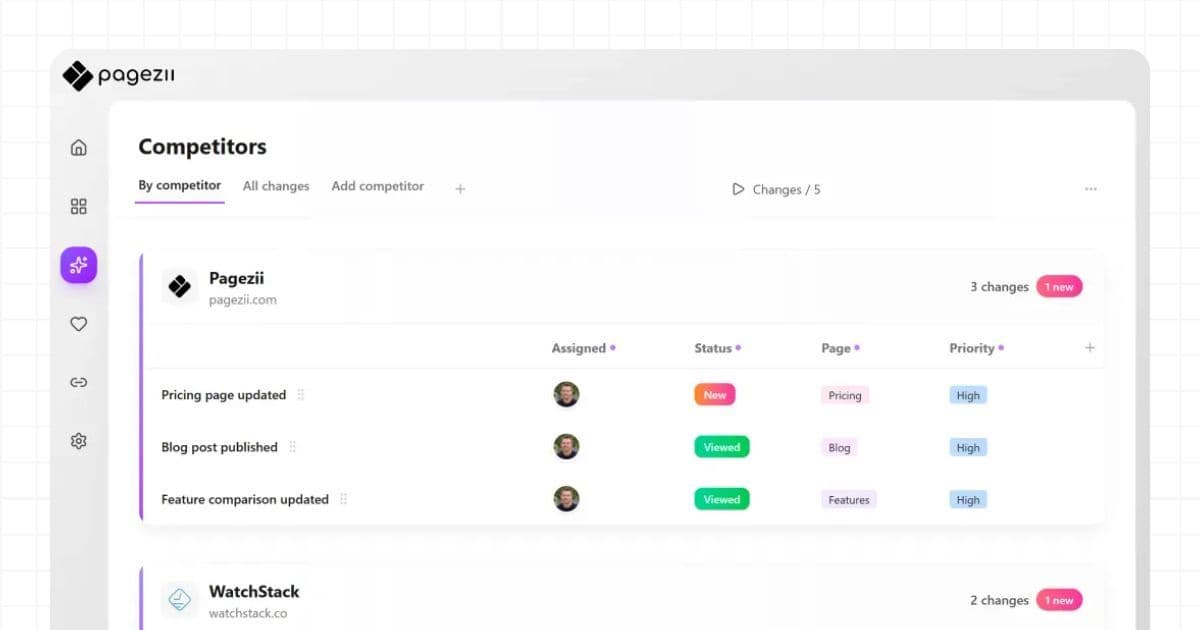
Pagezii monitors pricing, features, homepage, blog, and product pages continuously. When something changes, you get an alert with a summary of what changed and when. No manual checking required.
Start with just three competitors and four pages each. Pricing, features, homepage, blog. That focused setup catches most of what matters without adding noise.
Instead of manual competitor tracking, set up automated alerts once and let Pagezii surface pricing, features, and strategy changes for you.
About the Author

Zaki Usman
Co-founder Pagezii
Zaki Usman
Co-founder Pagezii
Zaki is Pagezii cofounder, a startup operator building practical software tools that solve market problems for founders and growth teams.
Frequently Asked Questions
Manual competitor tracking depends on someone remembering to check at the right time. Most teams check weekly at best, which means a competitor can reprice, launch a feature, or publish a strategic post in the gap between checks. By the time you notice, the window to respond has already narrowed.
Audience Context
Written for founders and early-stage operators who track competitors manually and keep losing ground between checks. They care because missed signals cost deals.
Related Insights
- Competitor Pricing Change Alerts: Catch Moves Same Day — Spot pricing drops before your next demo
- The Real Cost of Manual Competitor Tracking — What missed signals actually cost you
- 30 Days of Automated Competitor Tracking — Week-by-week: what the tool produces
- Replace Your Competitor Tracking Spreadsheet — Switch from spreadsheet to alerts in one day
- Competitor Monitoring for Product Roadmap Protection — Catch product pivots before they hit your pipeline
References
- U.S. Small Business Administration. (2025, September 22). Market research and competitive analysis. https://www.sba.gov/business-guide/plan-your-business/market-research-competitive-analysis
- U.S. Department of Justice, Antitrust Division. (2024, July 7). 4.2. Evaluating competition among firms. https://www.justice.gov/atr/merger-guidelines/tools/evaluating-competition
- Gilad, B. (2015, July 30). Companies collect competitive intelligence, but don’t use it. Harvard Business Review. https://hbr.org/2015/07/companies-collect-competitive-intelligence-but-dont-use-it
- Forrester. (2026, January 22). Five findings about today’s market and competitive intelligence programs. https://www.forrester.com/blogs/five-findings-about-todays-market-and-competitive-intelligence-programs/
- U.S. Federal Trade Commission. (2013, June 10). Dealings with competitors. https://www.ftc.gov/advice-guidance/competition-guidance/guide-antitrust-laws/dealings-competitors
Disclaimer
This article is provided for informational purposes only. Pagezii aims to share practical insights on competitor tracking and market intelligence but does not guarantee completeness, accuracy, or specific business outcomes.