
Competitor DNS and Tech Stack Signals: The Intelligence Layer Most Teams Ignore
Synopsis
For technically aware founders and product leads. Explains what DNS changes, uptime shifts, and tech stack updates reveal about competitor intent. Three scenarios where technical signals surfaced moves before announcements. Covers how technical monitoring complements page-level alerts.
The Competitor DNS and Tech Stack Signal Layer Most Teams Never Look At
Competitor DNS and tech stack signals are the earliest indicators of strategic moves — and most teams never see them because they only monitor what a browser shows.
Most competitor monitoring focuses on what you can see in a browser. Pricing pages. Feature lists. Blog posts. Homepage messaging. These are the right things to track, and they surface a lot of useful intelligence.
But there is another layer of signals that most teams never look at — not because the signals are not valuable, but because they require looking below the surface of what a browser shows you.
DNS changes. Infrastructure shifts. Tech stack updates. These are the signals that surface strategic moves before they appear on any web page, before there is a blog post, before there is an announcement.
For founders and product leads who want early intelligence, this layer is worth understanding.
A new subdomain appears six weeks before the product launches. By announcement day, your competitor already has the sales motion, the content, and the head start.
What DNS Changes Tell You
DNS records are the internet's address book. They control how a domain resolves, where traffic gets routed, and what subdomains exist. When a competitor's DNS configuration changes, it is often because something is changing in their product or infrastructure.
The most useful DNS signal is new subdomains. Subdomains are typically created for specific purposes: a new product, a new market, a new tool or integration. A competitor adding "app2.competitor.com" or "eu.competitor.com" or "api.competitor.com" is telling you something about where they are building, even if they have not announced it yet.
A competitor adding geographic subdomains is a six-to-eight week warning of international expansion. By announcement day, they already have infrastructure, pricing, and sales motion ready.
A concrete scenario: a competitor adds a new subdomain that follows the naming pattern of a specific product category. Six weeks later, they announce a new product in that category. Teams monitoring DNS caught the signal six weeks early. Teams monitoring only web pages found out on announcement day.
New subdomain patterns to watch:
- Geographic subdomains (eu, uk, ca) signal international expansion
- Product-specific subdomains signal new product lines
- API subdomains signal platform or integration investment
- Beta or staging subdomains signal active product development
What Tech Stack Changes Reveal
Every website runs on a collection of tools: analytics platforms, customer support software, payment processors, marketing automation, chat tools, A/B testing frameworks. These are largely invisible to a regular visitor but detectable through technical monitoring.
When a competitor changes their tech stack, the specific change is often a signal about where they are investing operationally or strategically.
A competitor adding enterprise support software or a new payment processor is easier to read than a blog post. Tools do not lie about intent the way marketing language does.
Three examples:
- A competitor switches from Intercom to a more enterprise-grade support platform. This often signals they are moving upmarket and starting to serve larger customers with more complex support needs.
- A competitor adds a new payment processor that handles international currencies. This signals geographic expansion before any public announcement of international availability.
- A competitor adds an A/B testing framework where they did not have one before. This signals they are investing in conversion rate optimization, often because they are about to run a growth experiment — sometimes on pricing, sometimes on onboarding.
None of these changes are definitive on their own. But each one is a data point about where a competitor is heading, often months before they say so publicly.
What Uptime Data Tells You
Uptime monitoring is less strategically rich than DNS and tech stack monitoring, but it occasionally surfaces something useful.
Extended downtime or repeated uptime issues can signal a major infrastructure migration. Companies moving from one cloud provider to another, or rebuilding their infrastructure for scale, often experience a period of instability. A competitor that is intermittently down over a two-week period may be in the middle of a significant platform transition.
Why does that matter? A competitor undergoing a major infrastructure migration is often temporarily slower to ship new features. If you are in a competitive sales cycle during that window, you may have an advantage in product velocity arguments that you would not have in a normal period.
Uptime data is most useful as context for other signals, not as a standalone indicator.
How to Combine Technical Signals with Page-Level Monitoring
Technical signals are most powerful when they are combined with page-level monitoring. A competitor who adds a new subdomain, changes their payment processor, and publishes a blog post about a new use case in the same two-week period is sending a strong combined signal about strategic direction.
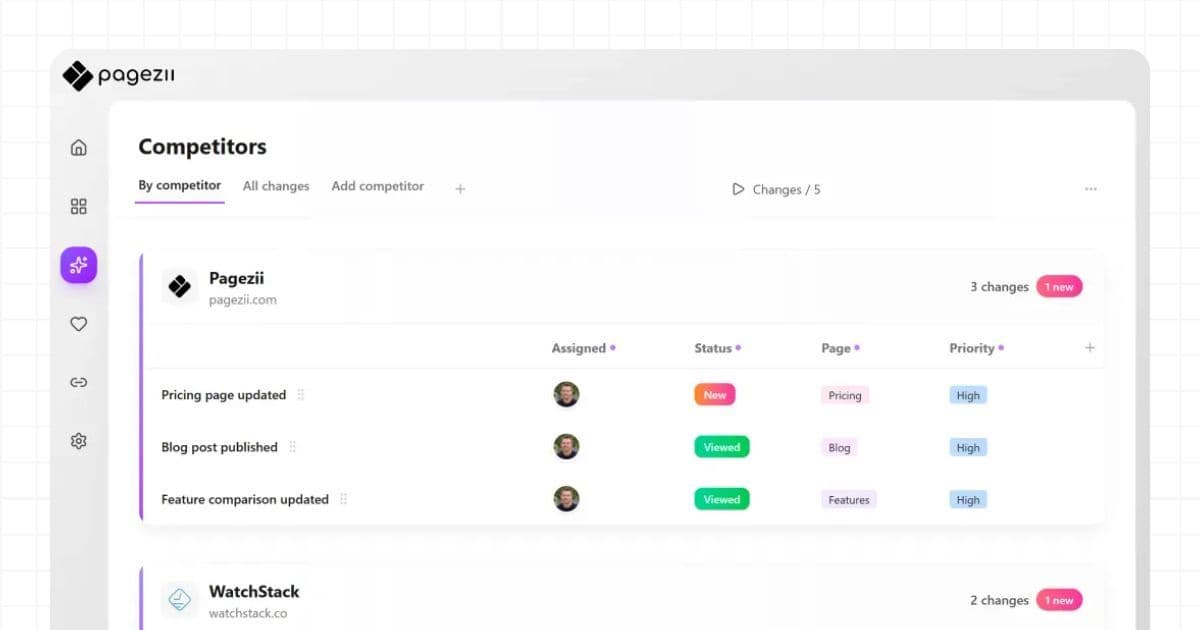
Pagezii monitors both layers. Page-level changes — pricing, features, homepage, blog — are tracked continuously with alert-based notifications. DNS and tech stack changes are surfaced through the technical monitoring layer and included in the weekly summary and per-competitor reports.
For a look at how product teams use these signals together to protect their roadmap, read competitor monitoring for product roadmap protection.
For a look at how page-level pricing changes specifically affect sales conversations, read competitor pricing change alerts.
Three Scenarios Where Technical Signals Delivered Early Intelligence
To make this concrete, here are three realistic scenarios where technical monitoring surfaced a strategic signal before any public announcement.
- Scenario one: A competitor adds three new geographic subdomains over a two-week period — eu.competitor.com, uk.competitor.com, and au.competitor.com. Eight weeks later, they announce international availability with dedicated regional infrastructure. Teams monitoring DNS had eight weeks to decide whether to accelerate their own international plans or prepare differentiated messaging for the regions the competitor was about to enter.
- Scenario two: A competitor adds Stripe Billing to their tech stack, replacing a simpler payment integration. This signals they are adding subscription management complexity — probably multiple plans, multiple billing cycles, or usage-based pricing. Four weeks later, they announce a new pricing structure with annual billing options and a usage-based enterprise tier. Teams monitoring tech stack changes had four weeks of advance notice.
- Scenario three: A competitor adds a job board subdomain — jobs.competitor.com — and begins posting engineering roles for a specific type of infrastructure (data pipeline, machine learning). Six months later, they announce a new AI-powered feature. Teams monitoring DNS caught the hiring signal early. It was not conclusive on its own, but combined with blog content moving into adjacent topics, the picture was clear enough to inform roadmap prioritization.
Getting Started with Technical Monitoring
Technical monitoring requires no technical knowledge on your part. Pagezii handles the detection automatically. You get the signal in plain language — a new subdomain appeared, a tech stack tool was added, an uptime anomaly was detected — alongside the page-level changes you are already tracking.
The combination of page-level and technical monitoring gives you a more complete picture of where your competitors are heading than either layer alone.
For a look at what the full monitoring workflow looks like across both layers, read 30 days of automated competitor tracking.
For a look at whether this level of monitoring is right for your company stage, read is Pagezii right for you.
Competitor DNS and tech stack signals surface strategic moves weeks or months before announcements — and Pagezii surfaces them for you automatically alongside page-level alerts.
About the Author

Marco Alvarez
Software Developer
Marco Alvarez
Software Developer
Marco is a software developer at Pagezii, building reliable backend systems and tools that collect, process, and organize competitor data.
Frequently Asked Questions
Competitor DNS changes reveal new subdomains, which often indicate new products, geographic expansion, or new infrastructure being built. A competitor adding a new subdomain is often making a strategic move that has not been announced yet — and DNS monitoring surfaces it weeks or months early.
Audience Context
For technically minded founders and product leads who want early signals before announcements. They care because surface-level monitoring leaves the most predictive intelligence invisible.
Related Insights
- Competitor Pricing Change Alerts: Same-Day Detection — Page-level signals that pair with technical ones
- Competitor Monitoring for Product Roadmap Teams — How product leads combine all signal types
- 30 Days of Automated Competitor Tracking — Full workflow including technical monitoring layer
- Is Pagezii Right for Your Company Type — Who benefits most from technical signal tracking
- Manual Competitor Tracking: What You Are Missing — Why browser-only monitoring leaves gaps
References
- Info-Tech Research Group. (2026, February 11). Sales teams lose competitive deals without disciplined competitive intelligence.
https://www.infotech.com/research/sales-teams-lose-competitive-deals-without-disciplined-competitive-intelligence-according-to-i - GTMnow. (2021, January 14). 5 best practices for using competitive intelligence in sales enablement.
https://gtmnow.com/sales-enablement-competitive-intelligence/ - SiftHub. (2026, March 4). Competitive enablement: What top sales teams know.
https://www.sifthub.io/blog/competitive-enablement - User Intuition. (2026, March 3). Market intelligence: The complete guide.
https://www.userintuition.ai/posts/market-intelligence-complete-guide/ - MixBright. (2026, February 23). Market research and intelligence: Complete 2026 guide.
https://mixbright.com/market-research-and-intelligence-guide/
Disclaimer
This article is provided for informational purposes only. Pagezii aims to share practical insights on competitor tracking and market intelligence but does not guarantee completeness, accuracy, or specific business outcomes.