
Competitor Website Audit: 10-Point Checklist for Product Teams
Synopsis
An SEO audit on a competitor's site tells you where they're strong, where they're weak, and what they're planning. Here is a 10-point competitor audit checklist you can run today.
An SEO audit on your own site tells you what needs fixing. A structured audit on a competitor's site tells you where they're strong, where they're weak, and what they're planning next. Here's a 10-point competitor audit checklist you can run today.
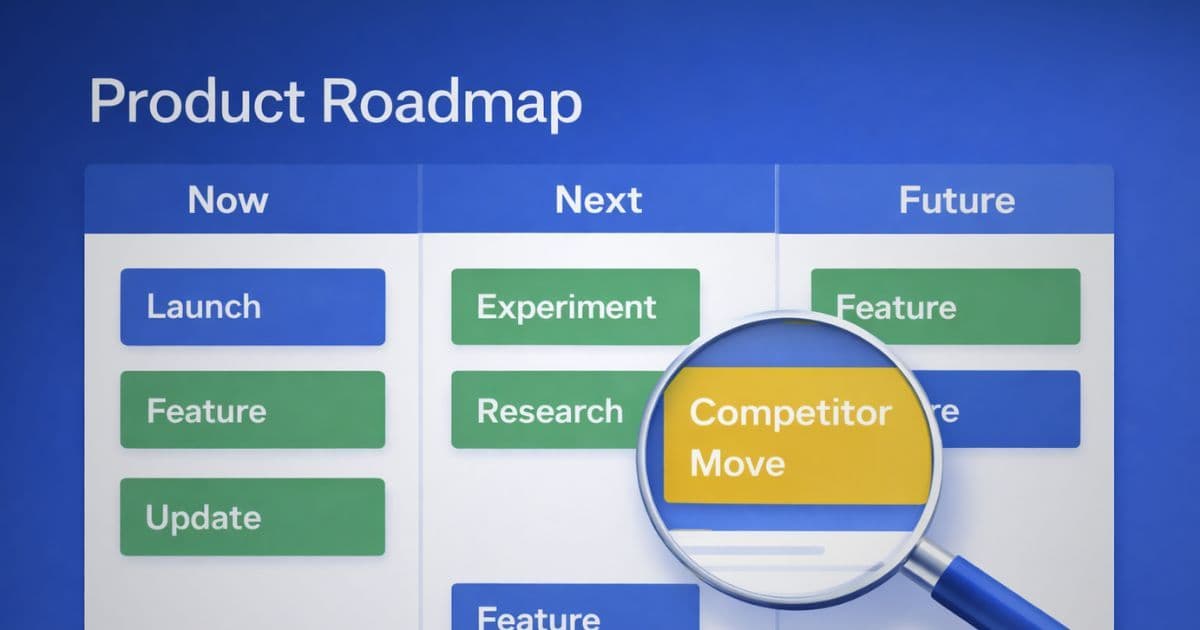
Competitor site audits reveal strengths, weaknesses, and strategic moves before they announce.
1. Homepage Messaging
Start with the headline. What problem do they claim to solve? What customer do they speak to? What proof points do they lead with? Screenshot the current version — this will be your baseline for tracking changes.
2. Pricing Page Structure
How many tiers? What features are gated? Is there a free plan, a trial, or a demo CTA? Pricing structure tells you their go-to-market motion and target customer size. Changes here are always strategic.
Note the language around pricing, not just the numbers. 'Starts at $X' vs 'Book a Demo' signals completely different sales motions.
3. Features Page Coverage
What capabilities do they highlight? What's absent that you'd expect to see? New sections on a features page often correlate with recent product launches. Absent features may represent a genuine gap — or a deliberate positioning choice.
4. Blog Topic Clusters
Categorize their last 20-30 posts by theme. Which customer segments do they address? Which use cases? Are there new themes emerging in their most recent content? This tells you about their acquisition strategy and target ICP.
5. CTA Strategy
What actions do they drive visitors toward? 'Try Free,' 'Request a Demo,' 'Talk to Sales' — each reflects a different conversion strategy. Check CTAs on the homepage, features page, pricing page, and blog posts. Consistency or inconsistency across these pages is itself a signal.
6. Social Proof and Case Studies
What customers do they feature prominently? What industries and company sizes? Case study subjects are a window into their best customers and their aspirational ICP. New case studies often follow closed deals in new segments.
7. Tech Stack
Use tools like BuiltWith or check page source to identify their analytics, marketing automation, CRM, and A/B testing tools. A competitor adding a new tool is often a signal of a strategic initiative — a new tracking stack means a new analytics push, a new CRM means a sales team investment.
8. DNS and Infrastructure
DNS changes can surface pivots before any public content does. A new subdomain might preview a new product or acquisition. Uptime patterns can reveal launch activity or infrastructure investment. These are signals most teams completely ignore.
Pagezii tracks DNS and infrastructure changes alongside page content — giving you a fuller picture of what competitors are building.
9. Messaging Language Shifts
Track the specific words competitors use to describe what they do. Shifts in category language — from 'tool' to 'platform' to 'OS' — are meaningful. So are new descriptors like 'AI-powered' or 'enterprise-grade' appearing where they didn't exist before.
10. Change History
The most important dimension of any competitor audit is time. A snapshot tells you what's true today. A change history tells you the direction — what they've added, removed, and repositioned over months. Change over time is where the strategic intelligence lives.
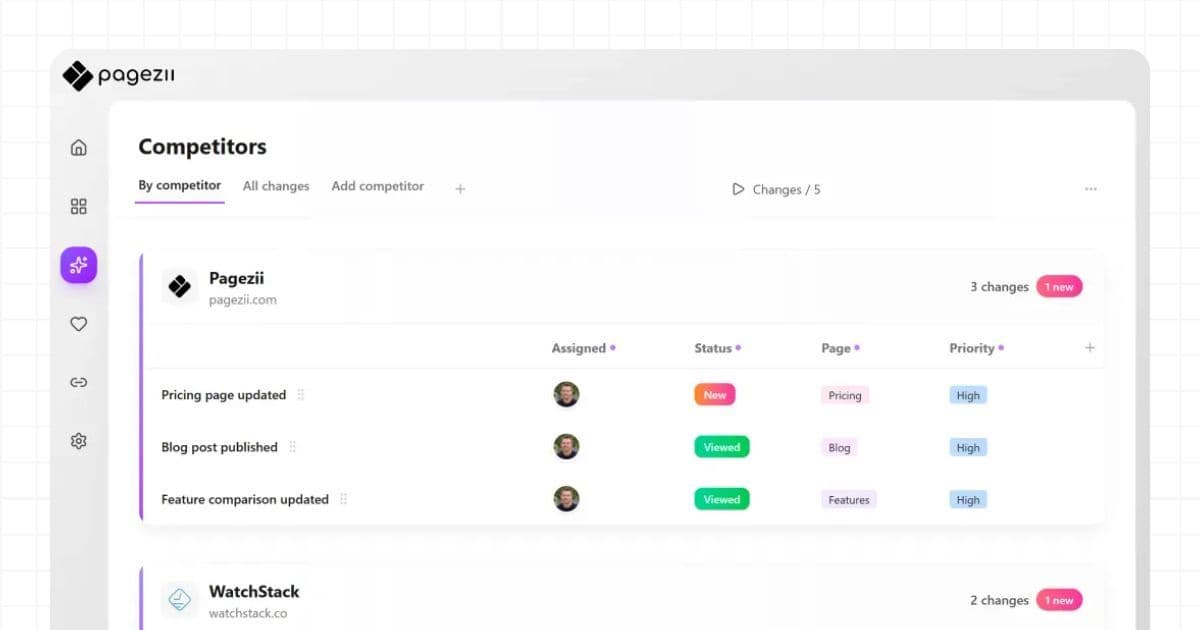
Pagezii maintains a change history for every page you're tracking, so your competitive audits always have the temporal context that makes them actionable.
About the Author

Jenna Gallo
Business Development
Jenna Gallo
Business Development
Jenna supports Pagezii’s business development, partnering with founders and teams while sharing insights on competitive intelligence and strategy.
Frequently Asked Questions
The pricing page. It reveals go-to-market motion, target customer tier, feature priorities, and conversion strategy — all in one place. Changes here are almost always strategic rather than cosmetic.
Audience Context
Product leads and founders who do periodic competitor reviews and want a systematic, repeatable audit framework that goes beyond surface-level observations to surface real strategic intelligence.
Related Insights
- On-Page SEO Checklist for Competitor Intelligence — Audit rivals across core on-page signals.
- Competitor DNS and Tech Stack Signals — Decode what rivals' tech choices reveal.
- Competitor Monitoring for Product Roadmap Protection — Guard your roadmap from rival feature launches.
- Monthly Competitor Intelligence Report Template — Structure insights into a repeatable report.
- Pagezii vs Klue: Which Competitor Tool Fits? — Compare features, pricing, and use cases.
- Replace Your Competitor Tracking Spreadsheet — Faster insights, less manual maintenance.
- Is Pagezii Right for You? — See if Pagezii fits your monitoring needs.
References
- Google LLC. (2024). Google Search Central: Search quality guidelines overview. Google Search Central.
- Porter, M. E. (2008). The five competitive forces that shape strategy. Harvard Business Review.
- Nielsen Norman Group. (2024). UX research cheat sheet. Nielsen Norman Group.
- U.S. Small Business Administration. (2024). Market research and competitive analysis. SBA.gov.
Disclaimer
This article is provided for informational purposes only. Pagezii aims to share practical insights on competitor tracking and market intelligence but does not guarantee completeness, accuracy, or specific business outcomes.