

Monthly Competitor Intelligence Report Template for SaaS Teams
Synopsis
Competitive intelligence only drives decisions when it's shared. This six-section monthly competitor report template helps product, sales, and marketing stay aligned on what rivals are actually doing.
Your team shouldn't have to chase down competitive insights. A consistent monthly competitor intelligence report — shared across product, sales, and marketing — keeps everyone aligned on what rivals are doing and what it means for your strategy.
A shared monthly competitor intelligence report keeps teams aligned on rival moves.
Here's a template you can adapt and run every month.
Section 1: Competitor Overview
Start with a top-level status update. For each competitor you're tracking, note: any major changes in the past 30 days, their current pricing, and their most recent product or messaging update. Keep this section concise — one to two lines per competitor. It sets context for the detail that follows.
Focus on changes, not just status. What's different this month vs. last month is the signal.
Section 2: Pricing and Packaging Changes
Track: Any new tiers, plan removals, or price point changes. Feature gating changes — what moved up or down a tier. Free trial or freemium changes. New pricing CTAs or sales motion shifts. Include a screenshot or summary of their current pricing page for reference.
Section 3: Feature and Product Updates
Track: New sections appearing on features pages. Feature removals or renames. New integration or partner announcements. Infrastructure or tech stack changes detected. Rate each change by estimated strategic significance — high, medium, low — so your team can prioritize what to dig into.
Section 4: Content and Messaging Shifts
Track: New blog topics introduced (especially ones with no prior coverage). Changes to homepage headline or positioning copy. New case studies or customer types featured. Shifts in the language they use for their category or product. These messaging signals often preview broader strategic moves.
Section 5: What We Noticed — Analysis
This is the highest-value section. Based on all the signals above, what does the team think these changes mean? Are they moving upmarket? Entering a new segment? Responding to a product gap? This is where observation becomes strategy.
Keep this section tight: two to three observations with a 'so what' for each. Don't over-analyze — the value is in synthesizing signal into a clear read on where competitors are heading.
A good competitive observation has three parts: what changed, what it probably means, and what (if anything) we should do about it.
Section 6: Action Items
Close each monthly report with specific actions. Assign each to a function — product, sales, marketing — with a clear owner and a suggested timeframe. Competitive intelligence that doesn't connect to action is just information. The monthly report's job is to drive decisions.
Making the Report Sustainable
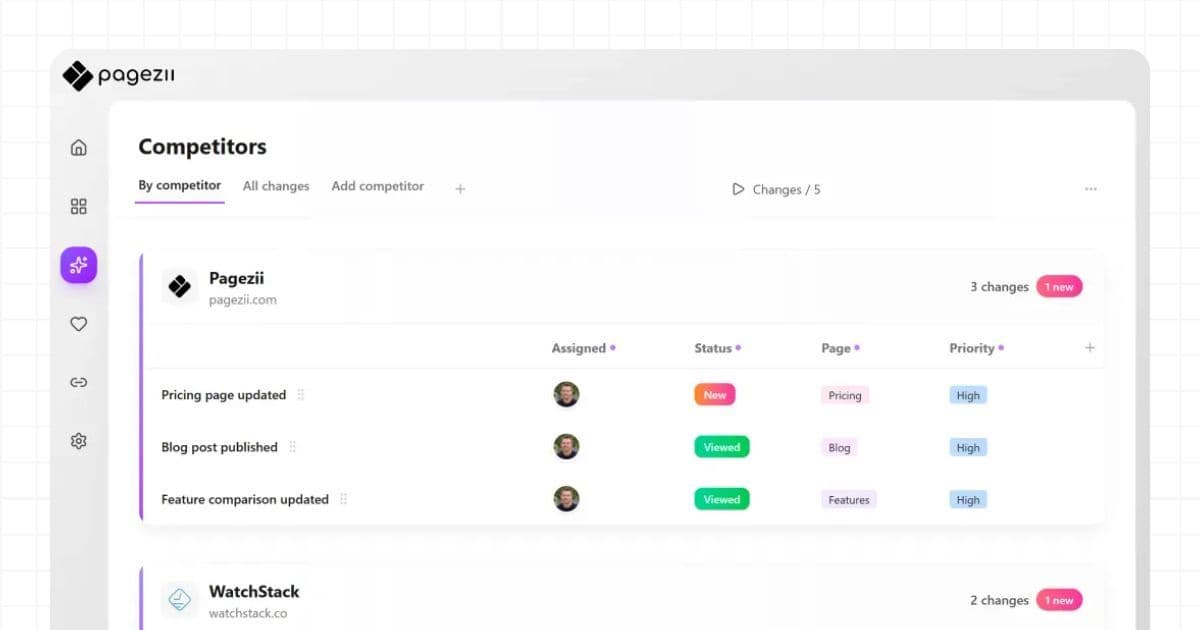
The biggest failure mode for monthly competitor reports is making them too hard to produce. If assembling the data takes four hours, the report will slip. The solution is automated collection — a tool that watches pages, records changes, and generates a summary so you're doing analysis, not data gathering.
Competitor reports fail when data collection is manual. Automate inputs so teams focus on analysis instead of gathering information.
Pagezii generates competitor summaries automatically, with per-competitor reports, change history, and PDF export. Your monthly competitor intelligence report becomes a 30-minute synthesis exercise instead of a half-day research project.
About the Author

Jenna Gallo
Business Development
Jenna Gallo
Business Development
Jenna supports Pagezii’s business development, partnering with founders and teams while sharing insights on competitive intelligence and strategy.
Frequently Asked Questions
Six sections: a competitor overview, pricing and packaging changes, feature and product updates, content and messaging shifts, analysis (what it means), and action items with owners. Keep each section concise and change-focused.
Audience Context
Marketing leads and founders at B2B SaaS companies who want to build a repeatable, shareable competitive intelligence process that turns competitor monitoring into monthly team-wide decisions.
Related Insights
- 10 Things to Audit on Any Competitor's Website — Benchmark rivals across key SEO metrics.
- Competitor Blog Metrics Guide — Track the blog signals that reveal rival strategy.
- 30 Days of Automated Competitor Tracking — Real data from a month of monitoring.
- Competitor Monitoring for Product Roadmap Protection — Guard your roadmap from rival feature launches.
- Replace Your Competitor Tracking Spreadsheet — Faster insights, less manual maintenance.
- Is Pagezii Right for You? — See if Pagezii fits your monitoring needs.
References
- Content Marketing Institute. (2024). B2B content marketing benchmarks, budgets, and trends. Content Marketing Institute.
- Gilad, B. (2015). Companies collect competitive intelligence, but don't use it. Harvard Business Review.
- U.S. Small Business Administration. (2024). Market research and competitive analysis. SBA.gov.
- MIT Sloan Management Review. (2016). Mastering the market intelligence challenge. MIT Sloan Management Review.
Disclaimer
This article is provided for informational purposes only. Pagezii aims to share practical insights on competitor tracking and market intelligence but does not guarantee completeness, accuracy, or specific business outcomes.