
On-Page SEO for Competitor Intelligence: What Rivals' Pages Are Telling You
Synopsis
On-page SEO isn't just for your own site. A competitor's title tags, headers, and pricing copy reveal their positioning shifts before any announcement. Learn how to read them systematically.
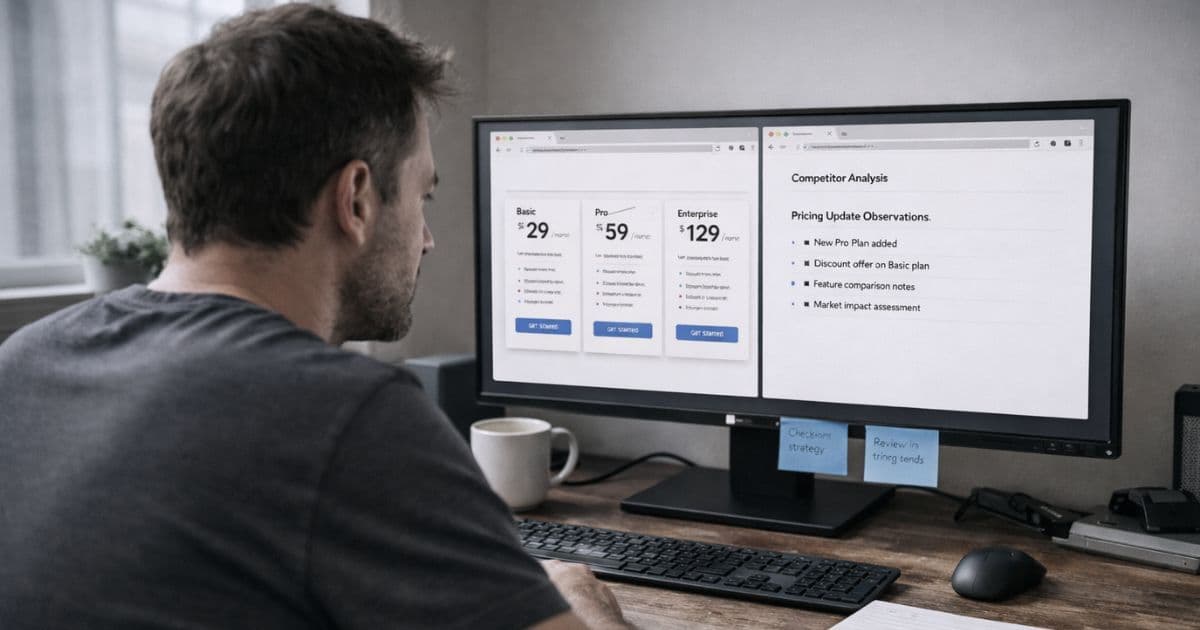
On-page SEO isn't just a tool for optimizing your own site. Every on-page element your competitor touches is a live signal about their strategy — their positioning, their customers, and where they're heading next.
Most founders only look at competitor pages once. They screenshot the pricing page, bookmark the features list, and forget about it. The problem is competitors don't freeze. They test, update, and reposition constantly. And the teams that catch those changes earliest are the ones who stay ahead.
Here's how to read competitor pages the way an SEO engineer reads a site — systematically, and with competitive intent.
Competitor pages constantly evolve. Systematically tracking on-page changes reveals shifts in positioning, product strategy, and target customers before the market notices.
1. Title Tags — The Clearest Signal of Positioning
A page title is the most deliberate copy a team writes. It's the first impression for search engines and for any visitor who finds the page. When a competitor changes it, they're usually signaling a repositioning.
What to watch for: A competitor whose title changes from 'Project Management Software' to 'AI Project Management for Remote Teams' has told you three things — they're leaning into AI, they're targeting distributed teams, and they see that angle as a competitive edge.
Track title tag changes on competitor key pages (homepage, pricing, features). A change here is almost never cosmetic
2. H1 and Header Hierarchy — Roadmap of Content Strategy
H1s and H2s reveal how a competitor is structuring their value proposition. The words they choose to bold, headline, and section off tell you what they believe their customer cares about most.
Look for: New sections appearing on a features page. A competitor who adds an H2 titled 'Security & Compliance' is telling you they're moving upmarket. One who adds 'Starts in 5 minutes' is pivoting to self-serve.
3. Pricing Page Copy — Strategy Made Public
Pricing pages are the most strategically dense content on any SaaS site. Every word on that page was debated. The plan names, the feature inclusions, the comparison table — it's all intentional.
Changes to watch: New plan tiers often signal expansion into enterprise or SMB. Feature gating changes signal what they've learned customers value most. Removing a plan entirely can mean consolidation or a move to sales-led.
Don't just watch the price numbers — the copy around price tells you as much as the price itself.
4. Feature Page Updates — Where the Product Is Going
New sections on a features page are roadmap leaks. When a competitor adds a section for 'Integrations' or 'Analytics,' they're either announcing what they've just shipped or planting a flag for where they're heading.
Removed or renamed features are equally valuable. A feature getting downplayed is usually one that didn't land with customers — a signal about product-market fit you can act on.
5. Blog Strategy — Who They're Targeting Next
A competitor's recent blog posts reveal the customers they're trying to acquire. Topics they've never covered before are a window into a strategic pivot. A cybersecurity tool suddenly writing about 'SOC 2 for startups' is going after a new customer segment.
Watch for patterns, not just individual posts. Three posts on the same theme in 90 days is a content strategy, not a coincidence.
New competitor blog topics are often a preview of the messaging they'll put on their homepage next quarter.
6. Meta Descriptions and CTAs — The Value Prop Under a Microscope
Meta descriptions are short, but they're often the most A/B tested copy on the site. Changes here can signal a shift in how a competitor frames their product against yours. Watch for new terminology, new comparison angles, or new urgency triggers.
CTA copy is similar. A competitor moving from 'Request a Demo' to 'Start Free' is signaling a go-to-market shift — from sales-led to product-led. That's a strategic change that should inform your own roadmap and positioning decisions.
7. Monitoring This at Scale
Reading all of this manually — across five or ten competitors — is not realistic. Most teams check competitors sporadically and miss the most important updates.
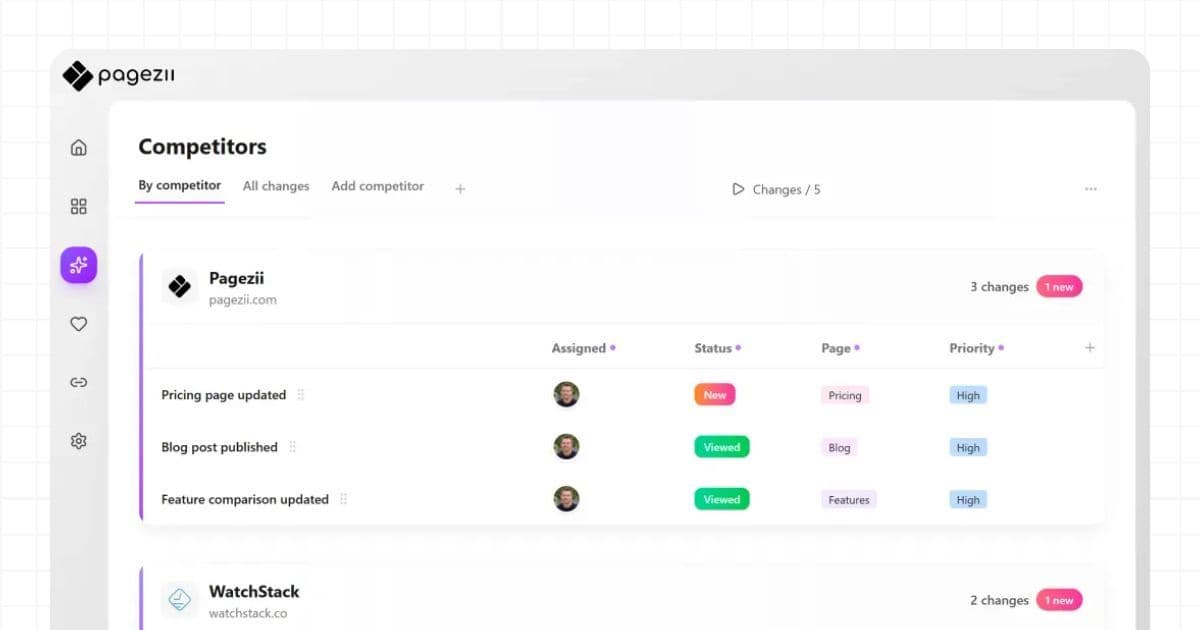
Pagezii watches your competitors' key pages 24/7 and sends you an alert when something meaningful changes. Pricing, features, homepage, blog — all tracked, all summarized, with historical context so you can see the pattern, not just the change.
About the Author

Anika Patel
Customer Support
Anika Patel
Customer Support
Anika helps Pagezii users with quick support, resolving issues and guiding users through the platform’s features and tools.
Frequently Asked Questions
A title tag change from 'Project Management Software' to 'AI Project Management for Remote Teams' signals a deliberate repositioning — new target audience, new category angle, or a pivot in go-to-market focus.
Audience Context
B2B SaaS founders and product marketers who manually check competitor websites and want a systematic framework for turning public page data into actionable competitive intelligence.
Related Insights
- Competitor Monitoring for Product Roadmap Protection — Guard your roadmap from rival feature launches.
- Manual Competitor Tracking: What You're Missing — Blind spots spreadsheets can't catch.
- 10 Things to Audit on Any Competitor's Website — Benchmark rivals across key SEO metrics.
- Competitor Pricing Changes: Catch Them Same Day — Real-time alerts before deals are lost.
- 30 Days of Automated Competitor Tracking Results — Real data from a month of monitoring.
- Replace Your Competitor Tracking Spreadsheet — Faster insights, less manual maintenance.
References
- Davenport, T. H., & Parra-Moyano, J. (2023, November 17). Use GenAI to uncover new insights into your competitors. Harvard Business Review.
- Porter, M. E. (2008). The five competitive forces that shape strategy. Harvard Business Review, 86(1), 78–93.
- MIT Sloan Management Review. (2016). Mastering the market intelligence challenge. MIT Sloan Management Review.
- U.S. Small Business Administration. (2024). Market research and competitive analysis. SBA.gov.
Disclaimer
This article is provided for informational purposes only. Pagezii aims to share practical insights on competitor tracking and market intelligence but does not guarantee completeness, accuracy, or specific business outcomes.