
Competitor Keyword Intelligence: A Two-Step Strategy for Founders
Synopsis
A competitor's keyword strategy reveals which customers they're going after and how they're building acquisition. This two-step framework maps their footprint and spots new moves before they scale.
Competitor keyword strategy reveals their go-to-market priorities. The topics they target and rank for show which customers they’re pursuing and where they’re investing in organic growth.
Most founders look at competitors statically. What matters is motion — the new topics and segments they’re entering before announcements appear.
Keyword intelligence makes those shifts visible. Here’s a two-step framework to track and use it.
Why Competitor Keywords Are a Strategic Signal, Not Just an SEO Metric
Standard keyword research focuses on search volume — which terms bring enough traffic to target. Competitor keyword intelligence is different: it reveals intent. The keywords and topics a company invests in show which customers they want and what strategic bets they’re making with content.
If a competitor publishes multiple articles on “enterprise security compliance,” they’re likely targeting that segment beyond SEO — often alongside a sales motion. Keyword patterns reveal go-to-market priorities.
The reverse also matters. When a competitor stops publishing in a topic they once covered, it may signal a shift in strategy or abandonment of that segment — both important signals to track.
Keyword patterns are customer acquisition signals. A single keyword tells you little. A cluster of related keywords, built consistently over time, tells you which segment a competitor is making a long-term bet on.
This is the core shift in how to think about competitor keywords: stop treating them as a list of terms to benchmark against, and start treating them as a map of where a competitor is investing and who they're trying to reach.
Step 1: Map Their Keyword Footprint to Customer Segments
The first step is not to collect a list of every keyword a competitor ranks for. It's to group those keywords into themes and map each theme to a customer segment. Volume matters less than pattern.
How to Group Competitor Keywords Into Themes
Start with the topics a competitor ranks for, not the individual keywords. Pull a sample of their top organic pages — their homepage, product pages, and highest-traffic blog posts. Look at the H1s, page titles, and content themes. Ask: which customer type is each piece written for?
A useful grouping structure for B2B SaaS competitors:
- Segment by company size — SMB-focused content ('for small teams', 'solo founder', 'under 10 users') vs enterprise-focused content ('enterprise security', 'compliance-ready', 'team of 100+')
- Segment by buyer role — technical buyer content (developer docs, API guides, engineering how-tos) vs business buyer content (ROI frameworks, executive reports, budget justification)
- Segment by use case — which problems does the content address, and who has those problems?
- Segment by funnel stage — awareness content (what is X?) vs consideration content (X vs Y, best X tools) vs decision content (X pricing, X alternatives)
Once you've grouped their content this way, a clear picture emerges: which segments does this competitor own in organic search, and which do they underinvest in? The gaps are as valuable as the coverage.
Look for keyword clusters that signal customer segment focus, not just individual keywords. A competitor with deep coverage in 'enterprise compliance' and 'SOC 2 readiness' is building a pipeline from that segment — likely with coordinated sales motions running alongside the content.
Reading the Competitive Positioning Map
Once you've done this exercise for two or three competitors, you can map the competitive landscape:
- Which segments are crowded with competitor content — meaning any content you publish there faces established authority?
- Which segments are underserved — meaning there's genuine organic opportunity and fewer entrenched competitors?
- Which segments are you already strong in, and where are you absent relative to the competitive field?
This map informs both your content strategy and your positioning decisions. A segment where multiple well-funded competitors are publishing heavily is a harder organic climb. A segment no major competitor is addressing through content is often a signal that the customer isn't being served well — and that's an opportunity.
Importantly, this map changes over time. A segment that was underserved six months ago may now have three competitors building content aggressively. Which brings us to the most valuable part of competitor keyword intelligence: tracking what's new.
Step 2: Track Which New Topics They're Entering
The single most valuable piece of competitor keyword intelligence is not what a competitor already ranks for. It's what they're newly targeting. First-time coverage of a topic is one of the clearest strategic signals available: it means a competitor has made a deliberate decision to invest in a new segment, launch a new feature, or reposition their messaging.
And it almost always appears in content before it appears anywhere else. Companies write about the problem space before they build the product that addresses it. They publish educational content before they run paid campaigns. They create search-optimized articles before they launch go-to-market motions. The first blog post on a new topic is the earliest public signal of a strategic shift.
When a competitor publishes three posts on a topic they have never covered, that is not content marketing. That is a product roadmap preview.
What Net-New Topic Entry Looks Like in Practice
Net-new topic entry has a recognizable pattern. It often starts with one exploratory post — usually a broad 'what is X' or 'why X matters' piece — followed within four to eight weeks by a more specific 'how to do X' post, and then a comparison piece ('X vs Y' or 'the best X tools for Z'). That three-post sequence is a content strategy, not a coincidence.
By the time a competitor has published that sequence, they've built a content cluster around a topic they had no presence in previously. They're six to twelve weeks ahead of any organic traction from those posts — but they're also six to twelve weeks ahead of you in signaling to that audience.
What to watch for specifically:
- New blog posts on topics with no prior history on their site — especially educational 'what is' or 'how to' formats that signal early-stage audience building
- New landing pages or feature pages targeting segments they haven't previously addressed
- Updated page titles that introduce new keyword angles — a features page renamed from 'Reporting' to 'Analytics for Enterprise Teams' is a segment pivot
- New comparison content ('X vs Competitor Y') that names your product — a signal they see you as a threat worth addressing in their acquisition content
- First-ever coverage of a regulatory topic, compliance standard, or industry-specific use case — these almost always precede a vertical go-to-market push
The Time Advantage of Catching Early Entry
The earlier you catch a competitor entering a new topic area, the more options you have. If you see the first post in a new cluster, you have several possible responses:
- Accelerate your own coverage of that topic before the competitor builds authority — especially if it's a segment you were already planning to address
- Use the signal as market validation — if a well-resourced competitor is investing content budget in a topic, that's evidence the segment has customer demand worth pursuing
- Identify what's adjacent to their new topic that they haven't addressed yet — the gaps around a competitor's new cluster are often the best organic opportunities
- Alert your sales team that a competitor is building content around a topic they may start using in customer conversations
None of these options require perfect information. They require timely information. Knowing a competitor entered a new topic cluster last week is far more useful than discovering it six months later when they've already ranked, built backlinks, and established audience familiarity with that content.
What to Do With Competitor Keyword Intelligence
Once you've mapped a competitor's keyword footprint and identified their net-new topic entries, you have three strategic options. Choosing between them depends on your current stage, resources, and positioning priorities.
Option 1: Go Head-to-Head
If a competitor is targeting a keyword cluster that directly overlaps with your core customer segment, you may need to compete directly. This means publishing content that targets the same queries, building similar content types, and out-executing them on depth, specificity, and authority.
Going head-to-head on keywords is only worth it if you have a genuine content quality advantage or enough publishing velocity to compete with a competitor who has a head start. If they've built six months of content authority in a cluster, you're climbing from behind — possible, but slower than the alternatives.
Option 2: Find the Adjacent Gap
The more efficient play is usually finding what the competitor is not covering. Every content cluster has gaps — sub-topics, adjacent use cases, and related audiences that the competitor's content doesn't address. These gaps often represent the lowest-competition, highest-relevance organic opportunities.
A competitor building enterprise compliance content probably isn't covering the 'compliance checklist for seed-stage startups' angle. A competitor targeting technical buyers probably isn't writing for the non-technical founder trying to evaluate the same category. Adjacent gaps let you build authority alongside a competitor's cluster without competing directly on their strongest terms.
Option 3: Use Competitor Coverage as Segment Validation
If a well-resourced competitor is investing in a topic cluster you were considering but hadn't prioritized, their investment is market validation. It means the segment has real customer demand — they wouldn't be publishing if the audience didn't exist.
In this case, the competitor's content investment de-risks your own. You don't need to pioneer the category; you need to enter it with differentiated positioning and a content quality bar that gives readers a reason to prefer your coverage.
Whichever option you choose, the decision is only as good as the timing of the intelligence. A strategic response to a competitor's new keyword cluster is most effective when it starts within two to four weeks of the competitor's first entry — not six months later.
Making Competitor Keyword Monitoring Sustainable
The most common failure mode for competitor keyword intelligence is doing it once and forgetting about it. A competitive landscape snapshot from six months ago is largely useless — the segments your competitors were targeting then may have already shifted, and the new moves they've made since won't show up in your stale research.
Consistency is what turns keyword intelligence from a research exercise into a competitive advantage. And consistency requires a system, not willpower.
What Consistent Monitoring Looks Like in Practice
A sustainable competitor keyword monitoring process has three components:
Automated page monitoring — a tool that watches competitor blog pages and key landing pages for new content and changes, without requiring you to remember to check
A weekly review rhythm — a consistent 15-minute slot where you process what changed and flag anything relevant to current roadmap or sales conversations
A lightweight sharing mechanism — a Slack message, a running doc, or a monthly summary that gets the intelligence in front of product, sales, and marketing without requiring a formal process
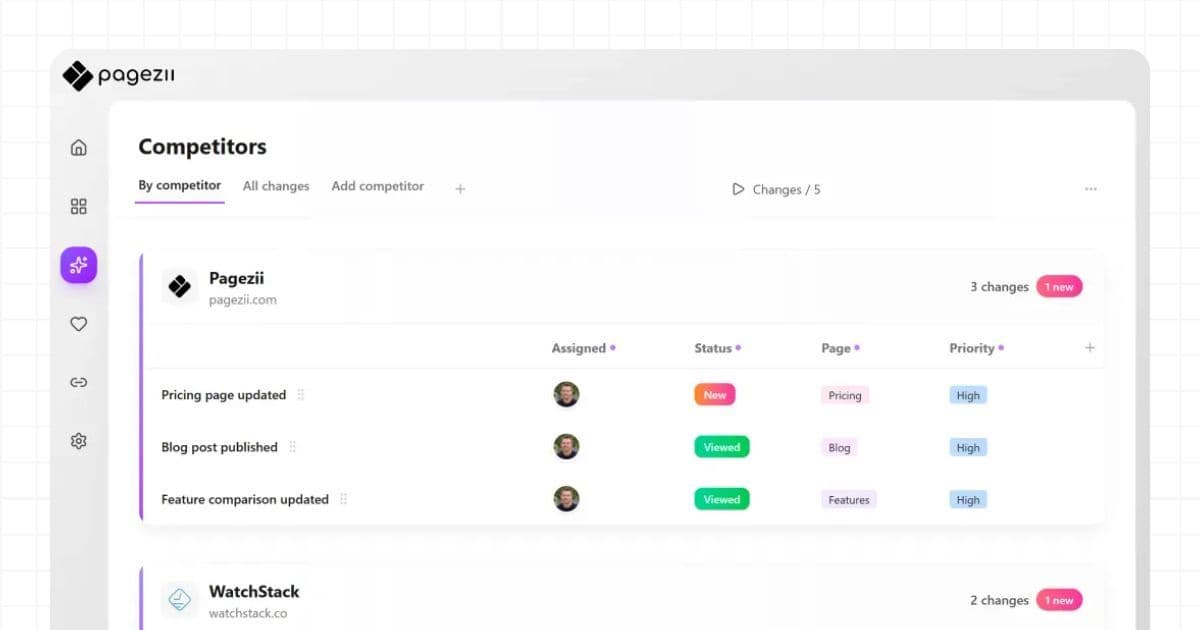
Pagezii handles the first component: automated monitoring of competitor blog and page activity, with weekly summaries and change-level alerts when something meaningful shifts. The review and sharing components take about 15 minutes per week once the collection layer is automated.
The teams that stay most consistently ahead of competitors aren't the ones who research most deeply once a quarter. They're the ones who see small signals consistently — the new topic entry, the updated page title, the shifted CTA — and build a response cadence around those signals.
About the Author

Youssef El Amrani
Product UX Desginer
Youssef El Amrani
Product UX Desginer
Youssef is a UX designer at Pagezii focused on intuitive SaaS interfaces, user research, and simplifying complex workflows.
Frequently Asked Questions
Clusters — not individual keywords — show which segments they're targeting. Deep coverage of 'enterprise compliance' keywords signals they're building a pipeline from that segment, likely with coordinated sales motions.
Audience Context
Growth-focused B2B SaaS founders who want to use competitor keyword targeting patterns to inform their own content strategy and identify under-served acquisition opportunities before rivals establish authority.
Related Insights
- On-Page SEO Checklist for Competitor Intelligence — Audit rivals across core on-page signals.
- 10 Things Competitor Content Tells You — Extract strategy from rival content gaps.
- Competitor Monitoring for Product Roadmap Protection — Guard your roadmap from rival feature launches.
- Competitor Pricing Changes: Catch Them Same Day — Real-time alerts before deals are lost.
- Pagezii vs Crayon: Feature and Pricing Comparison — Compare features, pricing, and use cases.
References
- Google LLC. (2024). How Google Search works: Understanding web content. Google Search Central.
- MIT Sloan Management Review. (2016). Mastering the market intelligence challenge. MIT Sloan Management Review.
- Content Marketing Institute. (2024). B2B content marketing benchmarks. Content Marketing Institute.
- Hagiu, A., & Wright, J. (2020). When data creates competitive advantage. Harvard Business Review.
Disclaimer
This article is provided for informational purposes only. Pagezii aims to share practical insights on competitor tracking and market intelligence but does not guarantee completeness, accuracy, or specific business outcomes.